About HagAstro
I'm Steven Hagler, an amateur astrophotographer in Dallas, Texas. HagAstro is where I share what I've captured: nebulae, galaxies and star clusters, plus the Sun, the Moon, the odd comet and eclipse, and the Milky Way from darker skies out west.
Nearly all of it is shot from my backyard under Bortle 8-9 skies, about as light-polluted as it gets. Narrowband filters and a lot of hours of exposure make up for that. A few images come from trips to darker skies: Lake Brownwood (Bortle 4-5) and Terlingua near Big Bend (Bortle 1, about as dark as skies get).
How it started
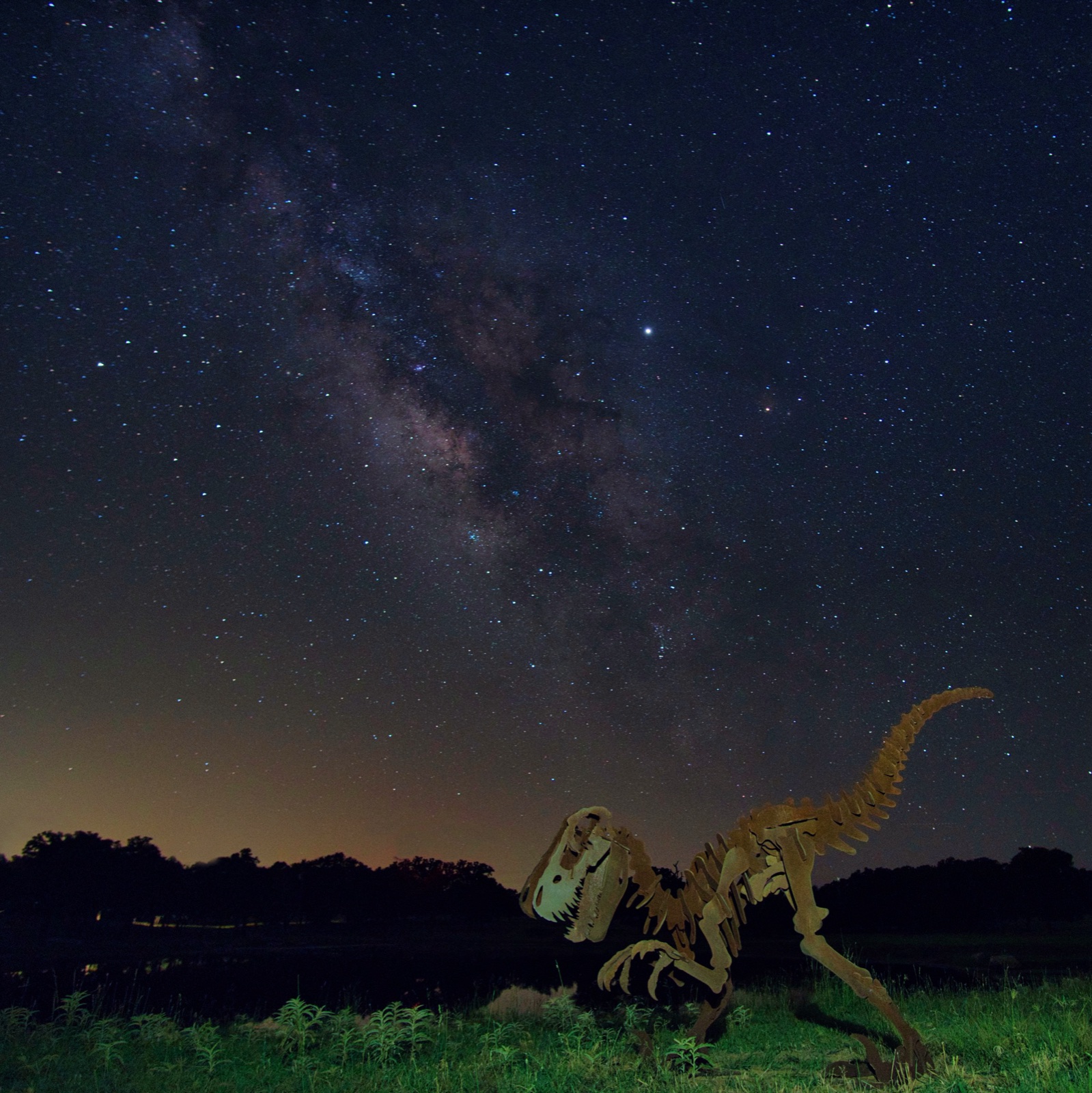
In June 2019 I took my Fujifilm X-E3 and a new Rokinon 12mm lens out to Bangs, Texas, and caught the Milky Way rising behind a steel T-Rex. That one photo made me want darker skies, so in August 2020 I made the long drive to Terlingua, out by Big Bend, under some of the darkest skies in the country. In April 2021 I bought my first tracking mount, a Sky-Watcher Star Adventurer GTi.
Deep-sky imaging started in the fall of 2022 with a William Optics Zenithstar 61 and a Canon 600D DSLR, both bought used. I wanted the rig to run itself as soon as possible: first I tried a Raspberry Pi, and in January 2023 I moved to a ZWO ASIAIR Plus, which has run capture, guiding and focusing ever since. That March I took the whole setup back to Terlingua.
Spring 2023 changed everything. In April the ZWO AM5 harmonic mount took over from the Star Adventurer, and in May the ZWO FF107APO became my main telescope and a cooled ZWO ASI533MM Pro mono camera took over from the Canon, along with my first narrowband filters. Narrowband passes only the light that glowing gas gives off, so for the first time I could pull nebulae out from under the Dallas light pollution; the North America Nebula that month was my first narrowband image. In March 2024 I upgraded to the ZWO ASI2600MM Pro, with a sensor more than twice the size.
Along the way came Seestar smart telescopes for long, easy runs from the backyard (an S50 in 2023, and an S50 Pro in September 2026), solar imaging (first a Coronado PST, then a Quark, now a spectroheliograph), and a third Terlingua trip in the spring of 2025. Seven years after the T-Rex, I'm still chasing the next clear night.
Gear
A · Main rig
- ZWO FF107APO refractor: 107 mm, 750 mm focal length (f/7), 4-element flat-field apochromat
- SVBony 60 mm guide scope: 240 mm focal length (f/4), multi-coated achromat
- ZWO ASI120MM guide camera: 1.2 MP (1280 × 960), about 3.2″/pixel on the guide scope
- ZWO EAF electronic autofocuser
- ZWO 0.75x reducer: brings it to about 560 mm (f/5.3) for wider fields
- ZWO filter wheel with Antlia V-Series Pro LRGB and Antlia 3 nm Pro Ha / OIII / SII
- ZWO ASI2600MM Pro cooled mono camera: APS-C 26 MP sensor (6248 × 4176, 3.76 µm pixels); 1.8° × 1.2° field of view at 1.03″/pixel, or 2.4° × 1.6° at 1.38″/pixel with the reducer
- ZWO ASIAIR Plus controller, on the tube rings: runs capture, guiding and focusing
- ZWO AM5 harmonic (strain-wave) mount
- ZWO TC40 carbon-fiber tripod, with extension column
B · Smart telescopes
- ZWO Seestar S50: 50 mm, 250 mm focal length (f/5), 3-element apochromat; 1/2.8″ 2 MP sensor (1080 × 1920), 1.46° field of view
- ZWO Seestar S50 Pro: 50 mm, 260 mm focal length (f/5.2), 4-element apochromat; 1/1.2″ 8.3 MP sensor (2160 × 3840), 2.8° field of view, plus a 63° wide-angle camera for the Milky Way and star trails
- Leveling base, under the S50
- Move Shoot Move wedge, under the S50 Pro: tilts it for equatorial (EQ) mode, so it tracks without field rotation on long runs
- Tripod (one under each)
C · Solar rig
- SVBony SV48P refractor: 102 mm, 663 mm focal length (f/6.5), multi-coated achromat
- 3D-printed mounting plate
- Solar finder
- 2.5″ dual-speed, rotatable focuser
- MeLE Quieter 4C mini PC, on the focuser’s dovetail opposite the solar finder, running SharpCap
- MLAstro SHG700 spectroheliograph: a slit and diffraction grating isolate one spectral line, such as hydrogen-alpha at 656.3 nm; the dial turns the grating to pick the line, and micrometers fine-tune it
- ToupTek 678M camera: Sony IMX678 mono sensor, 3840 × 2160 (2.0 µm pixels); scans use a 3840 × 160 strip at 240 fps. On the SV48P that strip spans about 0.66° of sky, so the whole Sun (0.53° across) fits in one scan
Also in the kit
- William Optics Zenithstar 61 with the Flat61 field flattener, bought used in October 2022: my first telescope, now a second, wider scope
- ZWO ASI533MM Pro, the mono camera before the ASI2600MM
Solar, earlier
- Coronado PST, a 40 mm hydrogen-alpha solar telescope, bought used after the October 2023 annular eclipse: great for visual observing, not for photography
- DayStar Quark Chromosphere hydrogen-alpha eyepiece with a ZWO ASI174MM camera and a Sky-Watcher SolarQuest mount (2024), before the spectroheliograph
Earlier
- Canon EOS 600D DSLR, bought used in November 2022 and probably astro-modified (stars stay tight with no IR filter). My introduction to deep sky.
- Sky-Watcher Star Adventurer GTi, my first tracking mount (2021), until the AM5 arrived in April 2023
Processing
Images are stacked and processed in PixInsight, with RC-Astro's BlurXTerminator, NoiseXTerminator and StarXTerminator. More recently I've been using Claude Code to analyze the data and plan the processing.
Using my images
All images are © Steven Hagler / HagAstro. If you'd like to use one, please ask first: [email protected]